Every January we take the same call. The power bill came in at two or three times December, nobody changed anything, the air conditioning has barely run, and it was 58 degrees outside. Something must be broken.
Usually nothing is broken. What happened is that your heat pump stopped being a heat pump for a few hours, and the thing that took over costs several times more per hour to run. It is worth understanding the mechanism, because once you do you can tell an ordinary January from a real fault, and the real fault is expensive every single night it goes unfixed.
What a heat pump actually does
A heat pump does not make heat. It moves it. Even at 45 degrees there is a surprising amount of heat energy in outdoor air, and a heat pump is a refrigeration cycle run backwards to collect that heat and dump it inside your house.
That is why it is cheap to run. Because it is moving heat rather than generating it, a heat pump typically delivers somewhere around three units of heat for every one unit of electricity it consumes. No device that makes heat directly can beat that, because making heat directly is capped at one to one.
Why it starts to struggle below about 40 degrees
The catch is that the colder it gets outside, the less heat there is out there to collect, and the harder the system has to work to collect it. Capacity falls off exactly when your demand is rising. Every heat pump has a balance point, the outdoor temperature below which it can no longer keep up with the house on its own.
In west Pasco and Hernando that point lands somewhere around 35 to 40 degrees for most residential systems. Below it, the thermostat calls for supplemental heat.
Strip heat is a toaster the size of your air handler
Supplemental heat in almost every Florida home is electric resistance heat, commonly called strip heat or auxiliary heat. It is a bank of heating elements sitting in the air handler, and it is exactly the same technology as a toaster or a hair dryer, just larger. Typical residential banks run from five to twenty kilowatts.
It works, instantly and reliably. It also converts electricity to heat at one to one, which means that for the same hour of heating it costs roughly three times what the heat pump costs. Run that for a few hours on a handful of cold nights and you have your January bill.
So the first thing to understand is that a genuinely higher bill after a genuinely cold week is not an error. It is the system doing what it was designed to do.
Defrost cycles, and why cold air sometimes comes out during heating
Something else happens in that temperature range. When it is cold and humid, which is most of a Florida cold snap, the outdoor coil picks up frost. To clear it, the system briefly reverses itself into cooling mode, which heats the outdoor coil and melts the ice, and fires the strip heat indoors so you do not get a blast of cold air in the living room.
Seeing steam rolling off your outdoor unit on a January morning is normal. It means defrost is working. What is not normal is an outdoor unit that stays iced over and never clears, or defrost cycles that run every few minutes. Both point to a failed defrost control, a bad sensor, or a low refrigerant charge.
The three faults that turn a high bill into an absurd one
Here is where the diagnosis actually matters. A normal January costs more. These three make it cost far more than it should, and all three are fixable.
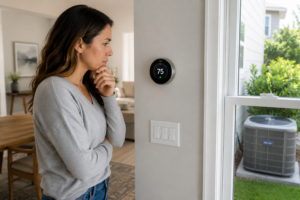
1. Emergency heat left switched on. This is the most common one and the cheapest to fix, because it is free. Most thermostats have an Em Heat or Emergency Heat setting that locks the heat pump out entirely and runs the house on strip heat alone. Someone flips it during a cold snap, the house warms up fast, and nobody ever flips it back. You then heat, and in some thermostat configurations continue to pay, on resistance heat for the rest of the winter. Go look at your thermostat right now. It should say Heat, not Em Heat.
2. Strip heat running when it is mild out. If the auxiliary heat indicator comes on when it is 55 or 60 degrees outside, that is a fault, not a quirk. The usual causes are a failed defrost board, a stuck reversing valve, a miswired or failing thermostat, or a refrigerant charge low enough that the heat pump cannot carry the load on its own. Every one of those is a real repair with a real payback.
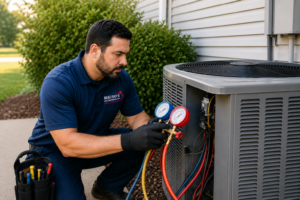
3. A low charge nobody has checked. A system slowly losing refrigerant looks fine in July and fails to keep up in January, because heating is the harder job. The strips quietly fill the gap on every cycle and the only symptom you ever see is the bill. This is one of the reasons we verify refrigerant charge on every maintenance visit rather than only when someone complains about cooling.
How to check your own system in about ten minutes
- Check the thermostat mode. Heat, not Em Heat. If there is an Auto setting and your system is a heat pump, Heat is the safer choice in winter.
- Call for heat and go outside. Set the thermostat three or four degrees above room temperature and walk out to the condenser. On a heat pump, the outdoor unit should be running when the house is heating.
- If the outdoor unit is silent while the house is warming, you are on strip heat alone. On a 40-degree night that may be correct. On a 60-degree afternoon it is not, and it is worth a service call.
- Watch the indicator. Most thermostats show AUX or EM when the strips engage. Note the outdoor temperature when it appears. If that number is well above 40, something is wrong.
Why October is the month to find all this out
Your heat side has not run since March. It has sat through seven months of Florida summer in a hot attic or a garage, and the first time you ask anything of it will be the coldest night of the year, at eleven at night, when every HVAC company in Pasco and Hernando County is already booked.
Run it for twenty minutes on a mild October afternoon instead. You will get the burnt dust smell out of the way on your own schedule, which is normal the first time and comes from dust that settled on the elements over the summer. What you are looking for is simple: does the outdoor unit come on, does warm air reach the registers within a few minutes, and does it shut off cleanly when it reaches setpoint. If any of those three does not happen, you have found your problem in October rather than in January.
Should you set the thermostat back at night?
This one surprises people, because the advice is the opposite of what it is for cooling. With a heat pump, a large overnight setback usually backfires. When you drop the temperature eight degrees at night and ask for it back in the morning, the thermostat sees a big gap between where the house is and where it should be, decides the heat pump cannot close it fast enough, and brings on the strips to catch up. You save a little overnight and then pay it back with interest at six in the morning.
A two-degree setback is fine. Eight is counterproductive. If you have a thermostat with an intelligent or adaptive recovery setting, turn it on, because it ramps the heat pump up gradually instead of triggering the strips.
When it is worth calling someone
Call if the auxiliary or emergency heat indicator comes on above about 45 degrees outside, if the outdoor unit ices over and never clears, if the house will not reach setpoint on a night in the forties, or if your bill jumped in a month that was not actually cold. Any of those is a fault, and faults on the heat side get expensive quietly rather than dramatically.
We service heat pumps, gas furnaces and electric air handlers throughout Hudson, New Port Richey, Port Richey, Trinity and Spring Hill. More detail on what a heating visit covers is on our heating services page, and if you would rather have it checked on a schedule than remember to do it, that is what the maintenance plan is for.
Call (727) 378-5727.